

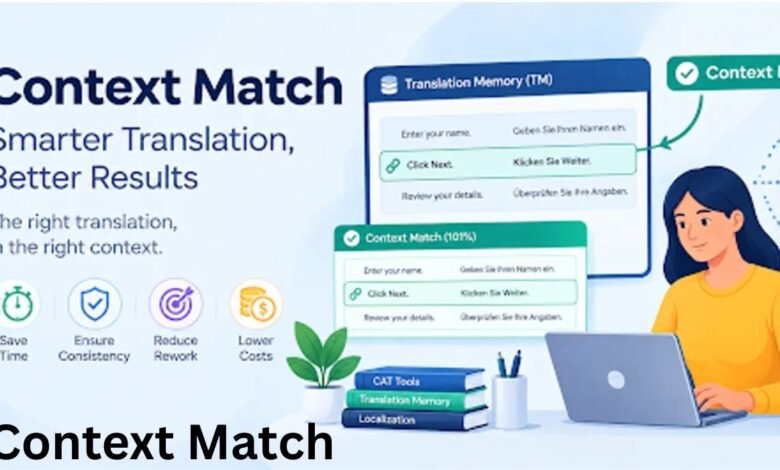
Context Match is an important concept in modern digital technology that helps systems understand information by examining its surrounding details. Instead of comparing words or sentences in isolation, this approach considers how information is used and what meaning it communicates in a particular situation. It is especially useful in translation technology, language processing, content management, and information retrieval. For example, the word “bank” can describe a financial institution or the land beside a river. Its intended meaning becomes clearer when the surrounding sentence is considered. Context Match helps address this type of ambiguity by looking beyond individual words. Although different software platforms may implement contextual matching in different ways, the central purpose is to produce more relevant and meaningful results. Understanding this concept can help translators, businesses, content professionals, and everyday technology users make better use of digital tools.
Quick Information Table
| Category | Information |
|---|---|
| Term | Context Match |
| Main Concept | Context-based matching |
| Primary Purpose | Improve matching relevance |
| Main Industry | Translation and technology |
| Related Technology | Translation Memory |
| Matching Approach | Context-aware comparison |
| Important Elements | Text and surrounding information |
| Common Users | Translators and content professionals |
| Key Benefit | Improved consistency |
| Additional Benefit | Reduced repetitive work |
| Related Method | Exact Match |
| Another Related Method | Fuzzy Match |
| Application Areas | Software and digital platforms |
| Main Challenge | Understanding complex context |
| Overall Importance | More meaningful matching results |
1. What Is Context Match?
Context Match is a specialized matching method commonly used in computer-assisted translation (CAT) software and translation memory systems. It identifies a sentence that matches previously translated content while also checking whether its surrounding context is consistent with the stored reference. Unlike a basic exact match, which focuses mainly on identical source text, a Context Match considers additional information, such as the preceding segment or other document details supported by the software. This distinction is important because the same sentence may require a different translation when it appears in another situation. By checking contextual information, translation tools can provide more reliable suggestions and help professionals maintain consistency across documents. The exact conditions for identifying a Context Match depend on the translation software being used.
2. How Does Context Match Work?
Context Match works by comparing a new text segment with previously stored information in a translation memory. First, the software checks whether the source segment matches an existing entry. It then examines the contextual information saved with that entry. Depending on the application, this may include the preceding segment, following segment, document structure, or other identifying information. If the required matching conditions are satisfied, the software can classify the result as a Context Match. For example, some translation tools consider the preceding segment when determining whether a context match exists, while other applications may support additional contextual elements. This process helps translators identify previously approved translations that are suitable for the current document and reduces unnecessary repetition.
3. Main Features of Context Match
The main feature of Context Match is its ability to evaluate both identical source text and relevant contextual information. In translation memory systems, this helps distinguish an ordinary exact match from a match that also satisfies additional context requirements. Another important feature is the reuse of previously approved translations, which supports consistency across related documents. Some CAT tools also consider document structure, segment identifiers, or neighboring text when evaluating matches. The available features depend on the software and its configuration. For example, one platform may primarily examine the preceding segment, while another may consider both preceding and following segments. These differences make it important for translators to understand how their chosen application stores and evaluates contextual information.
4. Context Match in Translation Technology
Context Match and Exact Match are closely related concepts in translation memory technology. An Exact Match generally means that the new source segment is identical to an existing segment stored in the translation memory. A Context Match goes further by checking whether the surrounding context also satisfies the software’s matching conditions. For example, a sentence may have exactly the same wording as an earlier translation, but its preceding segment may be different. In that situation, the software may classify it as an ordinary Exact Match rather than a Context Match. In some translation tools, a Context Match receives a 101% score because it includes both source-text and contextual agreement. This additional verification makes contextual matches more reliable for reuse in suitable translation workflows.
5. Context Match vs. Exact Match
Context Match and Exact Match are related concepts, but they do not necessarily describe the same process. Exact Match generally refers to content that meets strict matching conditions, such as identical wording or characters. Context Match considers additional information that helps establish whether the content is suitable in its current environment. For instance, an identical sentence might appear in two different documents with different surrounding information. A simple comparison may recognize the same wording, but a contextual system can consider whether the previous interpretation is appropriate for the new location. Some translation platforms also distinguish between an exact textual match and a context-confirmed match. The terminology and matching rules vary between software products. Understanding this difference helps users recognize why identical wording does not always guarantee that previously stored information is suitable for every situation.
6. Context Match vs. Fuzzy Match
Fuzzy Match and Context Match represent different types of translation memory results. A Fuzzy Match identifies source text that is similar to an existing segment but contains some differences in wording, structure, or other elements. Its match percentage is generally below 100%, depending on the software’s calculation method. A Context Match, however, requires an identical source segment together with additional contextual agreement. For example, a translation memory may identify a sentence with a 90% similarity score, making it a Fuzzy Match that requires translator review. If another sentence is identical to a stored entry and also meets the required context conditions, it may qualify as a Context Match. Understanding this difference helps translators decide how much attention a suggested translation requires.
7. Benefits of Using Context Match
One of the main benefits of Context Match is improved relevance. By considering additional information, a matching system can provide suggestions that better reflect the intended meaning. Another advantage is consistency, which is particularly important for businesses managing large documents or multilingual projects. Context Match can also reduce repetitive work by helping users locate previously approved information that may be suitable for reuse. This can save time and allow professionals to concentrate on more complicated tasks. In certain workflows, better contextual comparisons may also reduce unnecessary editing and improve information organization. However, these advantages depend on the quality of the reference material and the capabilities of the software. Context Match works most effectively when combined with reliable information, appropriate system settings, and human review.
8. Real-World Examples of Context Match
A practical example of Context Match can be found in a translation project containing repeated sentences. Imagine that a company has previously translated the sentence “Please contact our support team” in a product manual. Later, the same sentence appears in another version of the manual. If the source sentence and the required surrounding context match the previously stored translation memory entry, the CAT tool may identify it as a Context Match. However, if the sentence appears after a different preceding segment, the software may classify it as an ordinary Exact Match instead. Another example involves structured documents where headings, table cells, or segment identifiers help establish whether content belongs in the same location. These examples demonstrate how contextual information helps translators reuse earlier work more confidently.
9. Industries That Use Context Match
Context Match is primarily associated with translation memory systems and computer-assisted translation software. It is especially useful for translation agencies, localization companies, freelance translators, and businesses that regularly manage multilingual documents. Industries such as healthcare, technology, finance, manufacturing, and legal services can benefit from contextual matching when translating repeated or standardized material. For example, a software company may reuse approved interface translations across different versions of its application. Similarly, a manufacturing business may maintain consistent translations of product instructions and technical documentation. Other digital applications may use context-aware matching techniques, but they do not necessarily use the specific Context Match classification found in CAT tools. Understanding this distinction helps avoid confusing a specialized translation feature with contextual matching in general technology.
10. Common Challenges and Limitations
Despite its advantages, Context Match has certain limitations. One challenge is that surrounding information may not always provide enough detail to identify the intended meaning correctly. Complex sentences, specialized vocabulary, cultural expressions, and ambiguous language can make contextual interpretation difficult. Another issue is the quality of the reference material. If a system relies on outdated, incorrect, or poorly organized information, its matching suggestions may also be unreliable. Different software platforms may use different matching rules, meaning that results can vary between applications. Contextual comparison may also require additional processing and carefully configured information compared with simpler matching methods. For these reasons, users should not treat every automated suggestion as completely accurate. Reviewing important results and maintaining reliable source information remain essential practices.
11. How to Use Context Match Effectively
To use Context Match effectively, begin by understanding how the selected software defines and evaluates contextual matches. In translation tools, review the available translation memory settings and determine which contextual elements the platform considers. Keep previously approved translations organized and remove outdated or incorrect entries whenever necessary. Pay attention to document structure, terminology, and neighboring content because these details may influence matching results. When software provides a suggested match, examine whether its meaning fits the current sentence instead of accepting it automatically. Organizations should also establish consistent review procedures so that different team members follow the same quality standards. Regular maintenance and human verification can make contextual matching more dependable. These practices help users benefit from automation without treating it as a replacement for professional judgment.
12. The Future of Context Match
The future of Context Match is closely connected to developments in artificial intelligence, natural language processing, and intelligent information systems. Modern technologies are becoming increasingly capable of examining longer passages, identifying relationships between ideas, and interpreting language according to surrounding information. These developments may improve how translation applications, search engines, and digital platforms identify relevant results. AI-powered systems can also consider conversational history and document relationships when generating suggestions. However, advanced technology does not automatically guarantee perfect accuracy. Contextual understanding still depends on reliable information, appropriate system design, and careful evaluation. As these technologies continue to develop, Context Match is likely to remain an important concept for applications that need to interpret information more intelligently and deliver relevant results.
13. Why Context Match Matters in Modern Digital Workflows
Modern digital workflows involve large amounts of information that must be compared, organized, translated, and retrieved efficiently. Simple word-based matching may not always be sufficient because the same expression can have different meanings across industries, documents, and situations. Context Match helps address this challenge by considering the relationships between individual pieces of information. For businesses, this can support consistent communication and better content management. For translators, it can make previously approved material easier to reuse. For software users, it can improve the relevance of search and information retrieval functions. Its importance comes from the growing need for accurate and meaningful results rather than basic textual similarity. When implemented properly, contextual matching can support productivity, reduce unnecessary repetition, and improve the quality of digital work.
Frequently Asked Questions (FAQs)
1. What does Context Match mean?
Context Match refers to a method of comparing information while considering its surrounding details and intended meaning. It helps systems identify whether content is genuinely appropriate in a particular situation rather than relying only on identical words or surface-level similarity.
2. Where is Context Match commonly used?
Context Match is commonly used in computer-assisted translation software and translation memory systems. Professional translators and localization teams use it to identify previously translated segments that match both the source text and the required contextual information. Different CAT tools may apply different rules when identifying these matches.
3. Is Context Match better than Exact Match?
Neither method is universally better because they serve different purposes. Exact Match focuses on strict textual similarity, while Context Match considers additional information that may affect relevance. The appropriate method depends on the application and the type of information being compared.
4. How does Context Match improve translation accuracy?
Context Match can help translators identify whether an existing translation is suitable for a new sentence by considering surrounding text and other available information. This can reduce inappropriate reuse and improve consistency, although professional review is still necessary.
5. Does Context Match use artificial intelligence?
Context Match does not always require artificial intelligence. Some systems use predefined rules, structured information, or translation memory conditions. More advanced applications may combine contextual matching with AI and natural language processing to interpret information more effectively.
Final Thoughts
Context Match is an important concept in modern information processing because it focuses on understanding relationships rather than comparing words alone. Its applications in translation technology, digital publishing, search systems, and content management demonstrate how contextual information can improve relevance and consistency. Although it offers several advantages, its effectiveness depends on reliable reference material, suitable software, and careful human review. Understanding the differences between Context Match, Exact Match, and Fuzzy Match can help users make better decisions when working with digital tools. As technology continues to advance, contextual matching will remain valuable for creating more accurate, meaningful, and efficient digital workflows.