

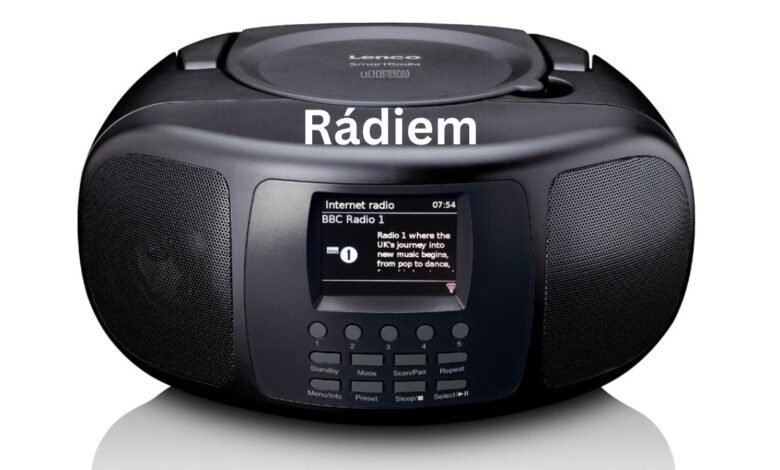
Some words become easier to understand when they are examined as part of a language’s grammar rather than translated on their own. Rádiem is one such example. It is a Czech form connected with the noun rádio, meaning “radio,” and its unusual ending reflects the grammatical role of the word in a sentence. For English speakers, this can initially seem confusing because English nouns usually do not change their endings in the same way. In Czech, however, noun forms can change according to case, number, and grammatical function. Understanding this particular form therefore provides a useful introduction to Czech declension and the way the language expresses relationships between words.
Quick Information Table
| Information | Details |
|---|---|
| Term | Rádiem |
| Base noun | rádio |
| Language | Czech |
| English equivalent | radio |
| Main grammatical role | Instrumental singular |
| Number | Singular |
| Gender | Neuter |
| Case | Instrumental |
| Basic idea | By radio / via radio |
| Dictionary form | rádio |
| Instrumental question | Čím? |
| Common function | Means or instrument |
| Related form | v rádiu |
| Word ending | -em |
| Main subject | Czech grammar |
The Basic Meaning
The easiest way to approach Rádiem is to begin with its dictionary form, rádio. In English, the word “radio” can describe both a device and the broader method of transmitting or receiving information. In Czech, Rádiem represents the instrumental singular form of the noun, and its ending shows how the word functions within a sentence. Depending on the context, Rádiem can be translated naturally as “by radio,” “via radio,” or “using a radio.” When learners encounter Rádiem in a Czech sentence, they should consider the surrounding words before choosing an English translation. This helps preserve the grammatical meaning of Rádiem instead of treating it as simply another spelling of “radio.”
How the Word Is Formed
Czech is an inflected language, which means that nouns can change their endings to show grammatical relationships. The basic form rádio appears in dictionary entries, while other forms are used when the noun has a different function. The ending -em in the form under discussion signals the instrumental singular. This is not a spelling variation or a new vocabulary item. It is simply another grammatical form of the same noun. Learning this distinction is particularly useful for beginners because Czech dictionaries generally list the base form, while actual sentences may contain a different version.
The Instrumental Case
The most important grammatical concept here is the instrumental case. Czech has seven grammatical cases, and each case can indicate a particular relationship between a noun and the rest of a sentence. The instrumental is commonly associated with an instrument, means, or method. It can answer the question čím?, which roughly corresponds to “with what?” or “by what?” in English. When radio is presented as the means through which an action happens, the instrumental construction can therefore be used. This is why recognizing the case is more useful than memorizing an isolated English translation.
Why Czech Uses Different Endings
For an English speaker, changing a noun ending may seem unnecessary, but it is an essential part of Czech sentence structure. English often relies on word order and prepositions to show relationships, while Czech can communicate some of the same information directly through noun endings. In Rádiem, for example, the ending helps identify the grammatical role of the noun within the sentence. A Czech speaker can therefore recognize how Rádiem relates to the action without relying entirely on word position. The change from rádio to Rádiem demonstrates how much grammatical information a small ending can carry. Understanding Rádiem in this way also helps Czech learners become more familiar with declension patterns and the wider case system.
Meaning in Communication
Radio is commonly associated with communication, so this grammatical form can appear naturally when discussing the method used to send information. For example, a situation involving pilots, emergency workers, transportation staff, or other professionals may involve communication through radio equipment. In English, a speaker might use the phrase “by radio” or “over the radio.” Czech can express the relationship differently because the noun’s grammatical form contributes to the meaning. The important idea is that the radio is being identified as the means or instrument connected with the action.
Difference Between Rádiem and V Rádiu
Learners should also distinguish this form from v rádiu. Although both expressions come from the same Czech noun, they have different grammatical functions. The form rádiu used after the preposition v is the locative singular form and is commonly encountered when talking about something being “on the radio,” such as a program, interview, or announcement. The instrumental form, by contrast, focuses on the noun as a means or instrument. Understanding this distinction can prevent awkward translations and helps learners recognize why Czech speakers choose different forms for apparently similar situations.
Examples of the Grammatical Idea
Consider a sentence in which radio communication is used to coordinate an activity. The important relationship is between the action and the communication method. In another situation, a technical system may use radio signals to communicate with another device. Again, the technology is functioning as a means rather than simply being mentioned as an object. These contexts demonstrate why translation should be based on the entire sentence. A direct word-for-word approach can sometimes produce unnatural English, while understanding the grammatical role makes the intended meaning much clearer.
Rádiem and Czech Declension
This word provides a useful example of Czech noun declension because it demonstrates that nouns do not always retain their dictionary spelling in normal sentences. Learners who only memorize vocabulary lists may recognize rádio but fail to identify its declined forms. Studying related forms together makes reading considerably easier. Once the learner recognizes common instrumental endings, an unfamiliar sentence can become easier to analyze. This is one reason grammar and vocabulary should be learned together rather than as completely separate subjects.
Common Learner Mistakes
Several mistakes can occur when someone first encounters this form. One is treating it as a completely separate word from rádio. Another is assuming that the ending can simply be removed whenever the learner wants the dictionary form. The surrounding grammar must always be considered. It is also easy to confuse this noun form with unrelated Czech words that happen to sound similar. Finally, translating it automatically as “radio” can lose the relationship expressed by the instrumental case. A more reliable method is to identify the base noun, determine its case, and then interpret its function in the sentence.
Why This Small Word Matters
Although it is only a single grammatical form, the example is valuable because it illustrates several broader features of Czech. It shows how cases influence noun endings, how grammatical information can be contained within a word, and why context matters when translating between Czech and English. These principles apply far beyond this particular noun. Once learners understand the basic idea, they can begin recognizing similar patterns with other words. In that sense, studying this form is not only about learning how to translate one expression; it is also about developing a better understanding of Czech sentence construction.
Relevance in Modern Czech
The grammatical form remains relevant because Czech grammar continues to operate independently of technological changes. Radio is still used in broadcasting and in several professional and technical environments, while wireless communication has expanded into many newer areas. Whether the context involves traditional broadcasting, communication equipment, or radio-based technology, the grammatical principles remain the same. Modern developments may change the devices people use, but they do not remove the Czech case system. This makes the word useful both as a language example and as part of vocabulary connected with communication.
Final Thoughts
Understanding Rádiem becomes much simpler once it is connected to the Czech noun rádio and the instrumental case. Rather than being an entirely different word, it is a grammatical form whose ending shows its role in a sentence. Its meaning can often be expressed in English with phrases such as “by radio,” “via radio,” or “using a radio,” although context determines the most natural translation. The distinction from v rádiu is also important because the two forms perform different grammatical functions. For Czech learners, this example demonstrates why studying noun cases is essential. A small change in an ending can provide information that English would normally express through additional words.
Frequently Asked Questions
1. What does Rádiem mean?
It is a Czech grammatical form related to rádio, meaning “radio.” Depending on context, it can express the idea of using radio as a means or instrument and may be translated as “by radio” or “via radio.”
2. What is the base form?
The dictionary form is rádio. The changed ending indicates that the noun is being used in a different grammatical role. This is a normal feature of Czech noun declension.
3. Which case is used?
It is the instrumental singular form. The instrumental commonly expresses an instrument, means, or method and can answer čím?, roughly meaning “with what?” or “by what?”
4. Is it the same as v rádiu?
No. The two forms have different grammatical functions. V rádiu is a locative construction commonly used for contexts such as being “on the radio,” while the instrumental form can express the means or instrument involved in an action.
5. Why does the ending change?
Czech nouns change their endings according to grammatical case and other grammatical features. The ending -em identifies the instrumental singular form in this example, allowing the noun’s grammatical relationship to be understood from its form.