

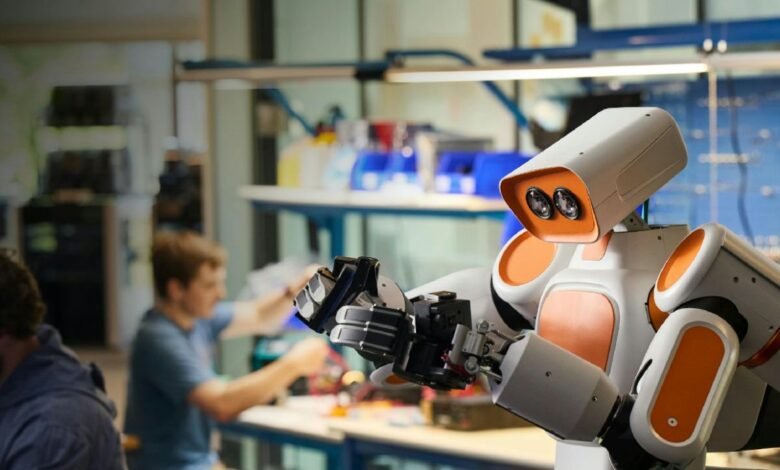
Robotics is entering a new stage in which intelligent machines are becoming more capable of working in real-world environments. From factories and warehouses to healthcare facilities, agriculture, and logistics, businesses are exploring robots that can perform repetitive, complex, or physically demanding tasks. Behind this development is a growing flow of investment. Robotics Funding gives companies the resources needed to develop hardware, improve artificial intelligence, build prototypes, test systems, hire specialists, and move products toward commercial deployment. Recent industry research shows strong investor interest in robotics and physical AI, although funding is increasingly focused on companies that can demonstrate practical applications and a path toward scalable business models.
Quick Information Table
| Data Point | Information |
|---|---|
| Main topic | Robotics Funding |
| Core technology | Robotics and artificial intelligence |
| Emerging concept | Physical AI and embodied intelligence |
| Main funding sources | Venture capital, corporate investment, grants, and private capital |
| Key development areas | AI, sensors, mobility, manipulation, and automation |
| Major industries | Manufacturing, logistics, healthcare, agriculture, and construction |
| Main funding purpose | Research, development, testing, production, and expansion |
| Important investor concern | Commercial scalability |
| Major cost area | Hardware development and manufacturing |
| AI contribution | Perception, planning, decision-making, and adaptation |
| Common business models | Hardware sales, licensing, subscriptions, and robotics-as-a-service |
| Major challenge | High development and deployment costs |
| Important success factor | Demonstrated customer value |
| Long-term goal | Reliable and scalable real-world automation |
1. Why Robotics Funding Matters
Building a useful robot requires much more than creating an intelligent software system. Developers must combine mechanical engineering, electronics, sensors, control systems, batteries, computing hardware, and software into one dependable machine. That process can require considerable time and capital. Robotics Funding helps companies move through these stages without having to depend entirely on early sales. Investment can support prototype development, laboratory testing, engineering teams, manufacturing preparation, and customer pilots. This is particularly important for startups because physical products usually require more resources before they can generate meaningful revenue than many software products. As robotics moves into more industries, access to suitable funding can determine which technologies successfully progress from an experimental idea to a commercially useful product.
2. How AI Is Changing Modern Robotics
Artificial intelligence is changing the investment outlook for robotics because it can make machines more adaptable. Earlier generations of industrial robots were often designed to repeat carefully defined movements in predictable environments. Newer systems can combine cameras, sensors, machine-learning models, and advanced software to interpret surroundings and respond to changing situations. This development is helping create what many researchers and investors describe as physical AI: intelligence that operates through machines interacting with the physical world. Current investment research identifies physical AI and robotics as increasingly important areas within the broader AI market.
3. Where Robotics Funding Is Being Used
Capital entering the robotics industry can be used at several stages. Early investment may support research, engineering, prototypes, and technical experiments. Later funding can help with field testing, certification, supply chains, production equipment, and hiring. Companies that already have commercial products may use new capital to increase manufacturing capacity or enter additional markets. AI-focused robotics businesses may also need funding for computing resources, data collection, model training, and software development. This makes robotics different from many purely digital businesses because successful commercialization requires both software development and physical production. Investors therefore need to understand the complete technology stack before evaluating the long-term potential of a robotics company.
4. Venture Capital and Robotics Startups
Venture capital remains an important source of funding for robotics startups. Investors generally look for companies with strong technical teams, a meaningful market opportunity, defensible technology, and evidence that customers need the product. Robotics can be attractive because a successful system may eventually serve large markets such as manufacturing, logistics, healthcare, or transportation. However, investors also face greater risks because hardware development can be expensive and product timelines can be long. Recent funding activity shows that investors continue to provide substantial capital to robotics companies developing physical AI, humanoid robots, and other automation technologies. For example, XPENG Robotics raised more than $900 million in August 2026, while Walden Robotics launched with $300 million in funding in July 2026. These deals demonstrate the scale of capital being directed toward companies attempting to develop and commercialize advanced robotic systems.
5. Corporate Investment and Strategic Partnerships
Large companies can provide another important route to robotics funding. Automotive manufacturers, logistics companies, technology firms, and industrial businesses may invest in robotics because automation can directly support their own operations. Strategic investment can also give a startup access to customers, manufacturing expertise, testing facilities, and industry knowledge. These advantages can be just as important as financial capital. A robotics company may have an impressive prototype, but real-world testing can reveal problems that are difficult to identify in a laboratory. Partnerships allow developers to discover those problems earlier and improve their systems before attempting large-scale deployment.
6. Government Grants and Research Support
Government programs and research institutions can also contribute to robotics development. Grants are particularly useful for projects involving advanced research where commercial returns may take years to materialize. Universities and technology organizations can use research funding to investigate areas such as autonomous navigation, machine vision, robotic manipulation, human-robot interaction, and advanced manufacturing. Grant support can reduce some of the financial pressure on early-stage projects and help researchers explore technologies that private investors may initially consider too risky. Public support can also encourage development in sectors where robotics may provide broader economic or social benefits. However, grants generally operate under specific requirements and are not a replacement for a sustainable commercial strategy.
7. Robotics-as-a-Service Creates New Opportunities
The traditional model of selling expensive robotic equipment is not the only option. Some companies are exploring robotics-as-a-service, where customers pay recurring fees instead of purchasing machines outright. This model can lower the initial financial barrier for businesses that want automation but do not want to make a large upfront investment. It can also give robotics companies recurring revenue when customers continue using the service. However, service-based models create additional responsibilities because providers may need to handle maintenance, software updates, repairs, monitoring, and fleet management. Funding therefore remains important even after the technology reaches the market. The business must be able to maintain its robotic systems while continuing to improve the underlying software.
8. Industries Driving Robotics Investment
Manufacturing remains one of the most established markets for robotics, but investment opportunities are expanding across several sectors. Warehouses are adopting automation to improve the movement and handling of goods, while healthcare organizations are exploring robotic systems for surgery, rehabilitation, laboratory work, and other applications. Agriculture can benefit from machines designed for monitoring, harvesting, and field operations. Construction and infrastructure companies are also examining ways robots can perform repetitive or dangerous tasks. Logistics and mobility remain important areas as well. Industry research covering robotics funding shows investment across multiple segments rather than one single application, demonstrating the breadth of the modern robotics market.
9. What Investors Look for in a Robotics Company
A technically impressive robot does not automatically make a successful investment. Investors also want evidence that the product solves a real problem and that customers are willing to pay for it. Important considerations can include prototype performance, production costs, intellectual property, management experience, customer relationships, market size, and the ability to scale manufacturing. A company that needs to customize every robot extensively may have difficulty growing efficiently. By contrast, a business with repeatable production and software that can improve across a growing fleet may have a more attractive long-term model. Investors are therefore increasingly interested in the connection between technical capability and measurable commercial results.
10. Challenges That Can Affect Robotics Funding
Robotics remains a capital-intensive field, and several risks can influence investment decisions. Hardware development may take longer than expected, component shortages can interrupt production, and robots may perform differently in real-world environments than they do during demonstrations. Safety is another major issue, particularly when machines work around people. Regulatory requirements can also affect deployment timelines. In addition, the industry faces the risk of excessive expectations when investors focus heavily on futuristic possibilities without sufficient evidence of near-term commercial demand. Recent developments in the robotics investment market show that financial markets can become more selective when companies struggle to demonstrate sustainable revenue or commercial progress.
11. Why Data Is Becoming Important to Robotics
AI-powered robots depend heavily on information about the environments in which they operate. Cameras, sensors, operating logs, and other sources can provide data that helps developers improve perception, navigation, decision-making, and task performance. As a result, a robotics company may gain value not only from its physical machine but also from the software and data systems supporting it. This creates another reason why Robotics Funding is increasingly connected with AI investment. Companies may need capital to develop models, collect high-quality training data, build simulation environments, and test systems under different conditions. At the same time, businesses must consider privacy, cybersecurity, data ownership, and responsible use when robots operate around workers, customers, or members of the public.
12. The Future Direction of Robotics Funding
The future of Robotics Funding is increasingly connected to physical AI, humanoid robots, industrial automation, and other systems designed to operate in the real world. Funding activity has grown strongly in 2026, with robotics startups attracting substantial investment as investors look beyond software-only AI toward technologies that combine artificial intelligence with physical machines. Crunchbase reported that global robotics startups had already raised $18.8 billion in 2026 by June, exceeding the full-year total recorded in 2025. Major individual deals also demonstrate the scale of interest: XPENG’s robotics business announced more than $900 million in funding in August 2026, with the money intended to support humanoid robotics, AI models, data collection, production, and expansion. These developments suggest that future funding will increasingly favor companies that can combine advanced AI with reliable hardware, practical applications, scalable production, and clear commercial demand.
13. Final Thoughts
Robotics Funding and the Future of AI-Powered Automation are closely connected because the development of intelligent machines requires substantial investment before many technologies can reach large-scale commercial use. Venture capital, corporate partnerships, government research support, and recurring service models can all help robotics companies move forward. AI is expanding what robots can potentially accomplish, while improvements in hardware and software are making physical automation more practical. However, strong funding alone cannot guarantee success. Companies still need dependable technology, realistic production plans, customer demand, responsible data practices, and a sustainable business model. As investors become more interested in physical AI, the strongest robotics opportunities are likely to be those that turn impressive technology into measurable real-world value.
Frequently Asked Questions
1. What is Robotics Funding?
Robotics Funding is capital provided to robotics companies, startups, research organizations, or projects to develop and commercialize robotic technology. It can come from venture capital firms, corporate investors, government programs, private investors, or strategic partners. The money may be used for research, prototypes, hiring, testing, manufacturing, marketing, and expansion.
2. Why is AI important for robotics?
AI allows robots to process information from their surroundings and potentially make more flexible decisions. Technologies such as computer vision, machine learning, and advanced planning systems can help robots recognize objects, navigate environments, and perform tasks that are difficult to manage with fixed programming alone. This is one reason physical AI has become an important investment theme.
3. Which industries receive robotics investment?
Manufacturing, logistics, healthcare, agriculture, automotive production, construction, and mobility are important areas for robotics development. Investment is also expanding into newer applications where robots can address repetitive work, difficult physical tasks, operational inefficiencies, or labor shortages.
4. What makes a robotics startup attractive to investors?
Investors generally look beyond the robot itself. They may evaluate the company’s technology, engineering team, intellectual property, customer demand, production costs, market opportunity, revenue model, and ability to scale. Evidence that customers are willing to use and pay for the system can significantly strengthen an investment case.
5. What is the future of Robotics Funding?
The future is likely to remain closely connected to AI, physical automation, humanoid systems, industrial robotics, and robotics-as-a-service. Current research indicates strong investor interest in physical AI and robotics, while companies are increasingly expected to demonstrate practical deployment and commercial potential.
